
You open the tumbler lid expecting sweet, crumbly compost and find a soggy, sour-smelling mess instead. In rainy regions, that scene plays out constantly — and it’s almost always a moisture problem, not a recipe problem. Composting works best when the pile feels like a wrung-out sponge, roughly 40–60% moisture, and getting there in a wet climate takes more deliberate management than most guides admit. If you’re weighing equipment for a damp region, it helps to know how well does the Miracle-Gro compost tumbler work in wet climates before you build your routine around it. Here’s how to hit and hold the right moisture level, rain or shine.
Quick Answer
A compost pile should be about as damp as a wrung-out sponge: 40–60% moisture, or roughly one or two drops of water when you squeeze a handful. In wet climates, the goal shifts from adding water to removing it — so you need more browns, better drainage, and a cover. Turn the pile when it smells sour, and add dry carbon material whenever rain pushes it past the sponge test.
Key Takeaways
- The squeeze test is more reliable than any schedule: one or two drops means correct moisture, a stream means too wet, and dust means too dry.
- Wet climates usually require 2–3 parts browns to 1 part greens by volume, not the standard 1:1 many guides suggest.
- Excess water displaces air, which is what actually causes the sour, anaerobic smell — not the water itself.
- A closed tumbler or a tarped pile slows rain intrusion, but it also traps moisture already inside, so turning and adding dry material still matter.
- Fix a soggy pile by adding shredded cardboard or dry leaves and turning — not by waiting it out.
What “Right Moisture” Actually Means in a Compost Pile
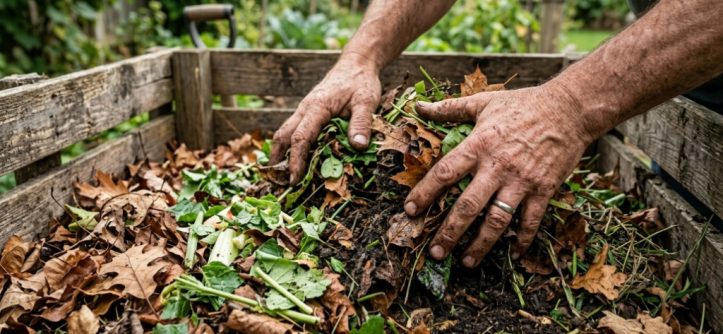
Compost moisture is a range, not a number. The target is 40–60% by weight, which is broad enough that you don’t need a meter to hit it. The practical test is the squeeze test: grab a handful from about 15–20 cm inside the pile, squeeze hard, and watch your hand.
- One or two drops — correct. The material holds together loosely and smells earthy.
- A steady stream or a wet palm — too wet. Air spaces are filling with water.
- No drops, material crumbles — too dry. Microbial activity slows sharply.
- Slimy, matted, or smells like vinegar or sulfur — anaerobic. This is the failure mode wet climates create most often.
Why the range matters: below roughly 40%, bacteria slow down and the pile stalls. Above about 60%, water fills the pore spaces between particles and pushes out the oxygen that aerobic microbes need. When oxygen runs out, anaerobic bacteria take over. They still break down material, but they produce organic acids and sulfur compounds — the reason a waterlogged pile smells bad rather than earthy, If you are preparing your raised beds or starting yard projects after finishing your soil work, learn best transplanter for texas gardens to plant your seedlings efficiently.
Why Wet Climates Break the Standard Composting Advice
Most composting guides are written for people who need to add water. If you garden somewhere with frequent rain, high humidity, or a short drying season, your problem is the opposite, and following standard advice can actively make things worse.
Three things change in a wet climate:
- Rain adds water faster than evaporation removes it. A pile can absorb significant rainfall through an open top, and evaporation from a covered or densely packed pile is slow.
- Humidity limits drying. Even a covered pile loses water slowly when the air around it is already saturated.
- Wet greens compact. Kitchen scraps and grass clippings mat down when soaked, sealing off airflow and creating anaerobic pockets.
The fix isn’t complicated, but it does require a different balance than the classic “equal parts greens and browns” formula. In practice, wet-climate composters often run closer to 2–3 parts browns to 1 part greens by volume, and they treat cover and drainage as core parts of the setup rather than optional extras.
How to Test and Adjust Moisture: A Practical Routine
Check moisture every time you turn the pile, and after any stretch of heavy rain. Adjust immediately rather than letting a wet pile sit — anaerobic conditions set in within days and take longer to correct than to prevent.
If the pile is too wet
- Add dry, coarse browns: shredded cardboard, newspaper torn into strips, dry autumn leaves, straw, or sawdust (in small amounts).
- Turn thoroughly to mix the dry material through the wet pockets rather than leaving it on top.
- Leave the lid open or the pile uncovered during dry weather so excess moisture can escape.
- Check again in two or three days. Repeat if the squeeze test still produces a stream.
If the pile is too dry
- Add water gradually while turning — a watering can or hose on a light setting works better than dumping.
- Mix in wet greens such as fresh grass clippings or vegetable scraps.
- Retest after 24 hours; dry material absorbs slowly and can read wetter on the surface than it is inside.
Particle size matters as much as water content
A pile of large, chunky material drains and aerates better than a pile of fine, compacted material, even at identical moisture levels. If your pile is consistently soggy despite reasonable brown-to-green ratios, the problem may be that everything is chopped too fine or that the greens have turned to sludge. Adding something structurally coarse — a handful of small twigs, wood chips, or shredded cardboard — can improve airflow more than adding more dry material of the same texture.
Choosing a System That Handles Rain
Your composting method determines how much moisture control you’ll be doing manually. Here’s how the common options compare for wet climates.
| System | Rain protection | Drainage | Turning effort | Best for |
|---|---|---|---|---|
| Open pile or bin | None | Good (ground contact) | High | Large volumes, dry climates, plenty of browns |
| Closed tumbler | High | Limited — relies on internal aeration | Low | Small yards, wet climates, household food scraps |
| Covered three-bin system | Moderate with a lid | Good | Moderate | Gardeners with steady material supply |
| Worm bin (vermicomposting) | High (indoors or sheltered) | Requires drainage tap | None | Small households, no yard space |
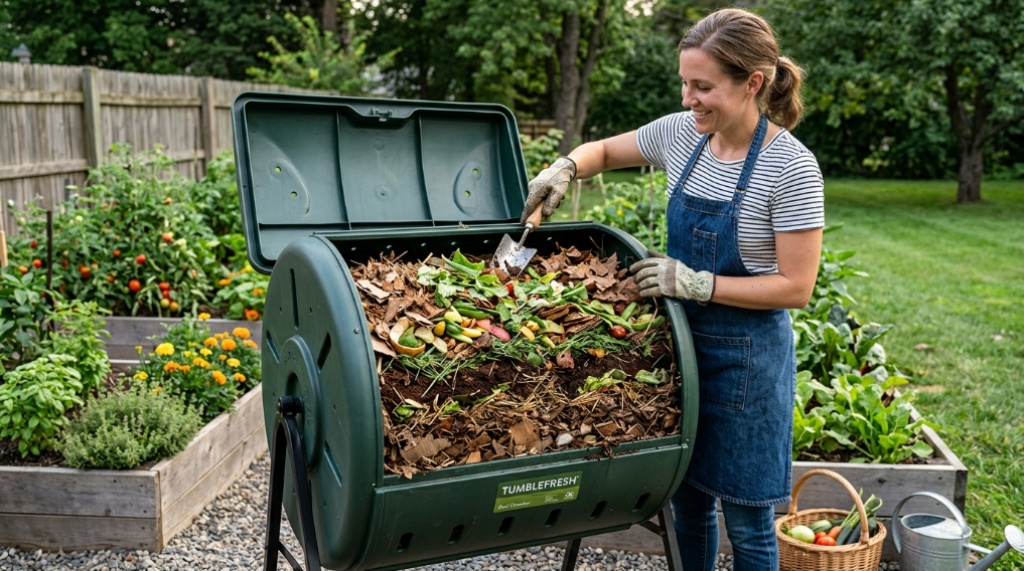
Closed tumblers are popular in wet regions precisely because they keep rain out. The trade-off is that they also keep moisture in. A tumbler loaded with wet kitchen scraps in a humid climate can turn anaerobic quickly, and because the drum is sealed, there’s less passive evaporation than in an open pile. That’s why tumbler users in wet areas typically need to add dry browns more aggressively and turn more often than open-pile composters.
If you’re specifically considering a dual-chamber tumbler, the design does help — one chamber can finish while the other is being filled, so you’re not forced to add fresh wet material to an almost-finished batch. But no tumbler solves drainage on its own, and anyone evaluating one should look at how it performs through a rainy season rather than on a dry test day.
Common Moisture Mistakes That Sink Wet-Climate Piles
These are the errors that show up most often, and each has a specific fix.
- Adding grass clippings in thick layers. Wet clippings mat into an impermeable sheet. Mix them in thinly or dry them first.
- Treating coffee grounds and vegetable scraps as “dry” additions. They’re wet. Account for them when balancing browns.
- Leaving the lid open in the rain “for airflow.” You’ll gain a little oxygen and lose the pile to saturation. Vent, don’t soak.
- Adding sawdust as the only brown. Fine sawdust compacts and holds water. Mix it with coarser material.
- Judging moisture from the surface. The top inch dries fast in wind and sun while the core stays soaked. Always sample from 15–20 cm in.
- Waiting for a soggy pile to dry on its own. Without turning and fresh browns, it usually just gets sour.
When to Stop Adjusting and Start Over
Some piles are past saving. If a pile has been anaerobic for weeks, is uniformly slimy, and smells strongly of rot even after you’ve added browns and turned it twice, the fastest path forward is usually to spread it out, let it dry in a thin layer, and restart with better structure. Finished or partially finished compost that went anaerobic isn’t necessarily ruined — it can often be salvaged by spreading and re-piling — but it will take longer than starting fresh with a properly balanced batch.
Prevention is cheaper than repair. In a wet climate, keep a store of dry browns under cover year-round so you always have material ready when the rain arrives. A bin of shredded cardboard takes up little space and can rescue a pile in a single afternoon.
Frequently Asked Questions
How do I know if my compost is too wet without a meter?
Squeeze a handful from the middle of the pile. One or two drops of water is ideal. A steady stream means too wet; no moisture at all means too dry. Smell is the second clue — sour or sulfurous odors indicate anaerobic conditions caused by excess water.
Can I compost in a rainy climate without a cover?
Yes, but it’s harder. An open pile in a wet climate will need frequent additions of dry browns and regular turning. A lid, tarp, or closed tumbler reduces how much rain enters and makes moisture easier to manage.
What are the best browns for soaking up excess moisture?
Shredded cardboard, torn newspaper, dry autumn leaves, and straw work well because they’re absorbent and coarse enough to preserve airflow. Sawdust absorbs water but compacts easily, so use it sparingly and mix it with a coarser brown.
Does a compost tumbler get too wet in humid weather?
It can. A closed tumbler blocks rain but also limits evaporation, so moisture from kitchen scraps stays inside. Tumbler users in humid regions generally need to add dry browns more often and turn the drum regularly to keep oxygen moving through the material.
How long does it take to fix an overly wet compost pile?
With dry browns mixed in and the pile turned, noticeable improvement usually shows within two to three days. A severely anaerobic pile may need multiple rounds of adding browns and turning over one to two weeks before it returns to a healthy, earthy smell.
Should I add water to compost in summer if it’s already damp?
No. Test first. If the squeeze test produces a drop, the pile has enough moisture regardless of how dry the surface looks. Surface dryness is normal and not a reason to water.
Conclusion
Managing compost moisture comes down to one habit: test with your hands, not a calendar, and adjust the moment the squeeze test goes wrong. In wet climates, that means keeping dry browns on hand, choosing a system that sheds rain, and turning whenever the pile smells sour. Get those three things right and the 40–60% target takes care of itself. Start by checking your pile today — if it fails the squeeze test, add shredded cardboard and turn it before the next rain.



Leave a Reply