
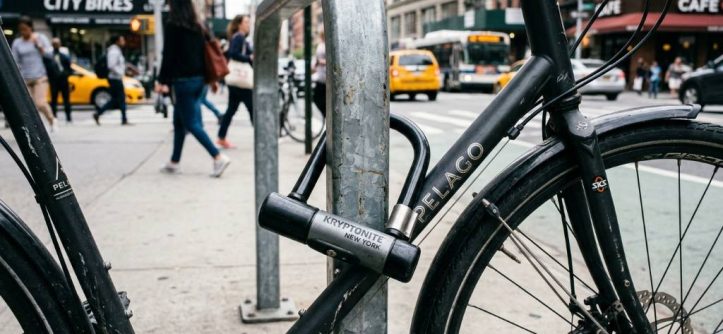
A quick coffee stop, a full day at the office, or an overnight park-and-ride — these are three completely different theft risks, yet most riders buy one lock and use it everywhere. That mismatch is exactly how bikes disappear. The right lock isn’t the heaviest or the most expensive one on the shelf; it’s the one that matches how long you leave your bike, where you leave it, and how much weight you’re willing to carry. If you want a concrete example of how a budget-friendly option can still cover everyday errands, check out this review of a five-digit combination lock built for short, practical stops.
Quick Answer
Match the lock to your stop length and location. For quick errands in low-risk areas, a lightweight cable or combination lock is usually enough. For commutes and longer stops in cities, use a quality U-lock or heavy chain with a reputable security rating. For overnight parking, use two different lock types together. Weight, locking technique, and where you attach the bike matter as much as the lock itself.
Key Takeaways
- Stop duration and location risk should drive your lock choice more than price or brand.
- U-locks and heavy chains resist cutting tools far better than thin cables, but cables are lighter and easier to carry.
- Security ratings from independent testing bodies give you a more reliable comparison than marketing claims.
- Locking the frame and one wheel to a fixed object defeats most quick theft attempts; locking only a wheel loses the bike.
- Two different lock types together are more effective than one expensive lock used alone.
Start With Your Riding Habits, Not the Lock
The most common mistake is shopping by lock type first. Instead, describe your typical week honestly. Where does the bike sit, for how long, and who can see it?
Ask yourself these four questions:
- How long is your longest regular stop? Five minutes at a bakery is a different problem from eight hours at a workplace.
- Is the location public and busy, or quiet and hidden? Thieves prefer spots with no foot traffic and no cameras.
- Do you lock to a proper rack, or whatever is nearby? A thin signpost or a loose fence rail can be defeated without touching your lock.
- How far do you ride, and do you carry bags? A three-kilogram chain is fine on a short commute and miserable on a 20-kilometre ride.
Once you answer those, the lock type usually chooses itself. A rider who parks inside a locked office bike room and a rider who leaves a bike outside a train station overnight should not be buying the same product, even if they ride identical bikes,
Before locking up on the city streets, make sure you are riding the right setup by checking out our guide on professional bmx bike for 2026.
Lock Types Compared: Which One Matches Your Stops
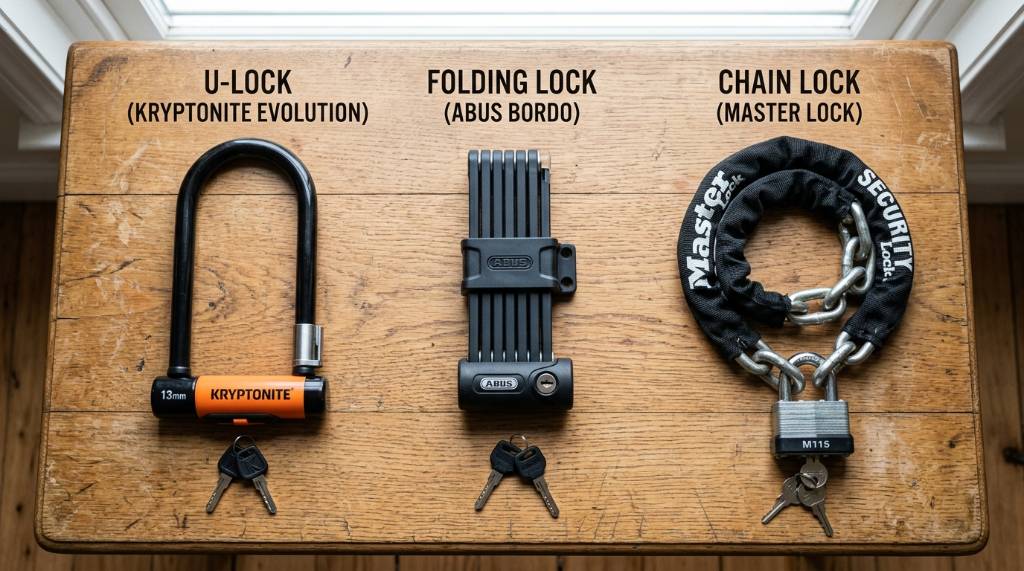
Each lock design trades security against weight, bulk, and convenience. There is no single winner — only the right fit for a specific habit.
U-Locks (D-Locks)
U-locks offer the best security-to-weight ratio for most urban riders. The hardened steel shackle resists bolt cutters and requires power tools to defeat. The main limitation is size: a short shackle is stronger but may not reach around thick racks and both a frame and wheel. Choose the smallest shackle that still fits your usual parking spots.
Chain Locks
Heavy square-link chains are extremely difficult to cut and flexible enough to wrap around awkward objects. The trade-off is weight — serious chains can weigh several kilograms. They suit riders who park in high-risk areas and don’t mind carrying the load in a backpack or frame bag.
Cable Locks
Cables are light, cheap, and easy to loop through wheels and frames. They also cut easily with basic hand tools. Treat a cable as a deterrent for low-risk, short stops rather than as primary protection in a city. A cable paired with a U-lock works well as a secondary wheel lock.
Combination and Folding Locks
Combination locks remove the key-carrying problem, which matters if you commute in clothes without pockets. Five-digit combinations offer far more possible codes than four-digit versions, which reduces the risk of someone guessing or brute-forcing the code. Folding locks sit between cables and U-locks: more cut-resistant than a cable, more compact than a chain, but with joints that can be a weak point on cheaper models.
What Security Ratings Actually Tell You
Independent rating systems exist precisely because manufacturer claims are unreliable. The most widely recognised schemes grade locks by how long they resist specific tools under controlled conditions. A higher rating means the lock survived longer against cutting, picking, drilling, or leverage attacks.
Two practical points about ratings:
- Ratings describe the lock, not your locking method. A top-rated lock attached to a flimsy rack still fails.
- Ratings are comparative, not guarantees. A determined thief with the right tools and enough uninterrupted time can defeat almost anything.
Use ratings to shortlist locks within your budget, then decide based on fit, weight, and how you’ll actually carry it.
Locking Technique Matters as Much as the Lock
A good lock used badly is barely better than a cheap one. The goal is to make the theft slow, noisy, and awkward.
- Lock the frame first. The frame is the most valuable and hardest part to replace. Capture it inside the shackle or chain.
- Include at least one wheel. A quick-release front wheel can vanish in seconds if it’s not secured.
- Attach to something immovable. Test the rack or post by pushing it. If it wobbles or lifts out of the ground, it’s not a secure anchor.
- Keep the lock off the ground. A lock resting on pavement gives a thief a stable surface to use leverage tools against it.
- Fill the shackle space. A loose, empty shackle gives a jack more room to work. Pack it tight with the frame and rack.
If you use quick-release wheels or an expensive saddle, consider locking skewers or a short secondary cable. These small additions close the gaps that thieves target most.
Weight and Portability: The Trade-Off Nobody Escapes
Security and weight move together. Every step up in cut resistance adds grams or kilograms, and that cost is paid on every ride, not just when you park.
A practical way to decide:
- Under 15-minute stops in low-risk areas: a light cable or compact combination lock carried in a jersey pocket or small bag.
- Commutes and errands of one to four hours: a mid-weight U-lock mounted on the frame or carried in a bag.
- All-day or evening parking in cities: a heavy U-lock plus a secondary cable or chain.
- Overnight or repeated high-risk parking: two different lock types, and ideally a location with cameras or staff.
Frame-mounted brackets keep the weight off your back, but they can rattle and don’t fit every frame. Backpack carry is secure but sweaty. Test how you’ll carry the lock before you commit to a heavy one — a lock left at home protects nothing.
Combination vs Key: Which Suits You Better
Keyed locks are generally faster to open and can be replaced or duplicated if lost. The downside is carrying a key, and losing it can mean leaving the bike behind. Combination locks eliminate that risk entirely, but the code can be forgotten, and cheaper mechanisms can be vulnerable to feel-based attacks.
If you choose a combination lock, pick one with more digits — a five-digit code gives significantly more possible combinations than a four-digit one — and avoid obvious patterns like birthdays or repeated digits. If you choose a keyed lock, keep a spare key somewhere other than the same keyring.
Common Mistakes That Undo a Good Lock
- Locking only the wheel. The frame walks away and the wheel stays.
- Using a cable as primary security in a city. Cables slow honest people and barely inconvenience thieves.
- Locking to a weak anchor. A thin post, a wooden fence, or a loose railing fails before the lock does.
- Leaving the lock on the ground. It gives tools a stable base and makes leverage attacks easier.
- Parking in the same spot at the same time daily. Predictable patterns help thieves plan.
- Buying the heaviest lock and never carrying it. An unused lock is zero security.
Frequently Asked Questions
Is a cable lock ever good enough?
Yes, for short stops in low-risk, visible locations where the bike is never far from you. For anything longer or in a city, pair a cable with a U-lock or use a chain instead.
How much should I spend on a bike lock?
Spend relative to your bike’s replacement cost and your parking risk. A useful rule is that the lock should cost a meaningful fraction of what it protects — a cheap lock on an expensive bike is a false economy.
Are combination locks less secure than keyed locks?
Not inherently. The mechanism quality and digit count matter more than the locking method. A well-built five-digit combination lock can be perfectly adequate for everyday commuting.
Should I use two locks?
For high-risk or overnight parking, yes. Two different lock types force a thief to carry and use two different sets of tools, which usually makes your bike a less attractive target than the one next to it.
Does locking the bike inside a garage or bike room remove the need for a lock?
No. Shared bike rooms are common theft targets because access is often loosely controlled. A lock is still worth using, even indoors.
How do I stop my quick-release wheel from being stolen?
Use locking skewers, or run a short secondary cable through the wheel and the main lock. Either approach closes the easiest theft opportunity on most bikes.
Conclusion
Choose your lock by matching it to your longest and riskiest regular stop, not your shortest. Light cables and combination locks handle quick, visible errands; U-locks and heavy chains handle commutes and city parking; two different locks handle overnight and high-risk situations. Then lock properly — frame and wheel to a solid anchor, shackle tight, lock off the ground. Get those two things right and you’ll avoid the vast majority of real-world bike theft.




Leave a Reply