
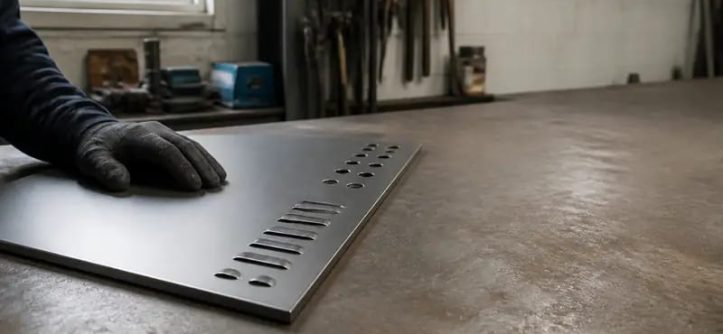
Punching and shearing both cut sheet metal, but in very different ways and for very different applications. Therefore, it is very important to try and establish which process will be required for a particular job in order to save a lot of time and costly tooling.
What Each Process Actually Does
When we talk about cutting sheet metal, we are talking about two very different processes. Both are used for cutting sheet metal but in very different ways. If you are making parts and your main requirement is to cut out individual parts from full sheets then shearing will be the process to use. However, if you are trying to create a product that contains features such as holes, cutouts or even louvres then punching will be the better option.
Edge Finish and What Happens Next
Both punching and shearing processes produce edges with burrs, which can be very sharp and even may interfere with subsequent processes (like powder coating or painting). As for edge finishing for welding purposes a sheared edge is better than punched one. For coating purposes, both processes need to be deburred first. The shape of the remaining burrs depends largely on the punch and die, particularly on their clearance.
Thickness and Sheet Size Limits
Shearing is best suited for long straight cuts across large width sheets of mild steel up to around 6mm thickness. Punching is generally limited by the sheet size that can be placed within the working area of the machine as well as the tonnage required for the material thickness. For example, if a cut is required to run the full length of a 2.5m wide sheet then shearing is the only option. However, if a dozen or so scattered holes of different diameters are required then punching is the only sensible option.
Setup Time for Short Runs
For short runs on jobs with a variety of parts containing a number of different sized holes (i.e. mixed batch work) tools can be changed very quickly on many of the Cotswold Machinery Punching Machines available. As a result such machines are often preferred for such work by workshops that need to produce a variety of different products of a bracket type with different numbers and combinations of holes. For such work the ability to change over between different parts quickly is a major factor.
Tooling Costs Over Time
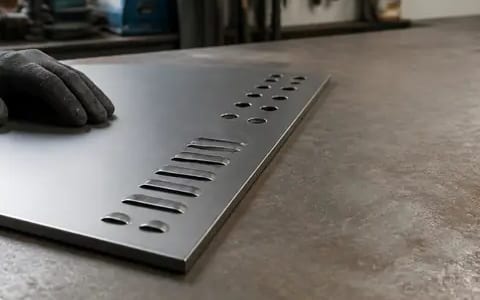
A shearing blade consists of one cutting edge which will need to be sharpened on occasion. However, this can be done several times before the blade will need to be replaced and each re-sharpen is generally fairly inexpensive. In contrast, a punching process uses separate punch and die tools for each hole shape and size. Thus, for example, a workshop punching round holes of three different diameters, a slot and a custom shape will require 5-6 separate tools each of which will have its own wear rate and eventual cost of replacement. This factor must be taken into account when quoting for work that will require the use of unusual hole shapes for which the workshop has no current tooling.
Material Waste Across a Sheet
Shearing of parts is typically more efficient at using up the whole of the sheet than punching as each hole makes a slug of waste that cannot be used. The waste between parts that have been nested on the sheet to make best use of it is referred to as skeleton waste. This can be reduced by using good sheet metal nesting software but there will always be some waste. For single simple parts that are to be cut from stock, shearing to make simple cut parts will generally be more economical in terms of raw material usage than punching an outline of the part.
Noise and Guarding Differences
Shears cut in a sharp, sudden motion while punching is generally a more continuous process, producing a higher frequency of sound for longer periods of time. When choosing between the two for the purposes of noise on a shift, it is worth remembering that the point of operation for a punching tool station will require point-of-operation guarding. This is in contrast to shears which will require full length guarding along the length of the blade. For both machines it is good practice to follow proper guidance for metalworking for the purposes of noise exposure in order to avoid potential problems with hearing. With proper noise control and hearing protection, both machines can be safely used in a workshop environment.
When a Job Needs Both
There are plenty of jobs around the workshop that will need the combination of shearing and punching. These could be jobs such as shearing down a large sheet to a panel size and then punching mounting holes or cut-outs in the finished panel. Many sheet metal jobs are processed in this order. If a job was to be processed in reverse (i.e. first punch then shear) there is a risk of cutting through a punched hole. So although shearing and punching are both distinct processes in their own right, it is the sequencing of these processes that will be more critical than which is ‘better’.
Matching a job with the right process, or even with the correct sequence of processes, is often the main difference between completing a task in the workshop smoothly and lots of extra time spent finishing off parts to complete a job.



Leave a Reply