
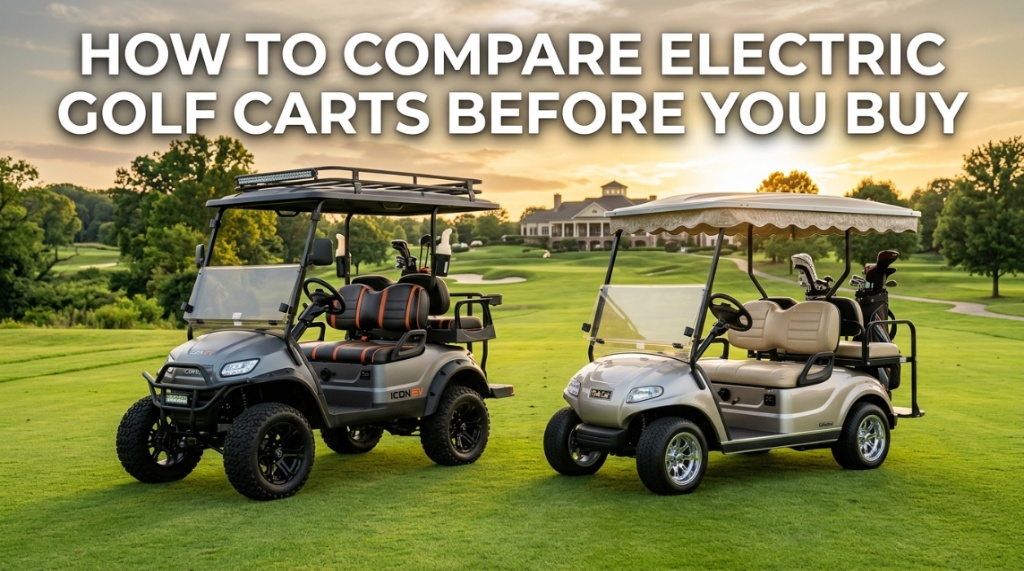
Two electric golf carts can look identical on a showroom floor — same body style, same seat count, same color — yet one outlasts the other by seven years and costs $3,000 less to own over its lifetime. The difference hides in specifications most buyers never check: battery chemistry, motor type, controller amperage, and charger intelligence. Comparing electric golf carts for adults properly means looking past the paint job and into the engineering that determines whether your cart still performs in year eight or dies in year three. Most comparison guides list surface features like cup holders and USB ports. This guide compares what actually matters — the components that determine range, longevity, power, and total ownership cost.
Electric golf carts now outsell gas models 3-to-1 in the adult personal-use market, according to 2024 industry data from the National Golf Cart Manufacturers Association. That surge means more options than ever — and more confusion. Between lithium vs. lead-acid, AC vs. DC motors, 48V vs. 72V systems, and dozens of brands competing for your money, a proper golf cart comparison framework saves you from expensive mistakes. Here’s how to evaluate electric golf carts for adults like an engineer, not a casual shopper.
What Are the Most Important Specs to Compare in Electric Golf Carts?
Battery type, motor type, voltage system, and controller amperage are the four specifications that determine 90% of an electric golf cart’s performance, range, and lifespan.
Here’s what each spec actually means for your daily experience:
- Battery type (lithium vs. lead-acid): Determines range, weight, lifespan, and maintenance requirements
- Motor type (AC vs. DC): Determines efficiency, torque delivery, regenerative braking capability, and longevity
- Voltage system (36V, 48V, 72V): Determines top speed, hill-climbing ability, and accessory power capacity
- Controller amperage (300A–600A): Determines acceleration response and maximum power delivery
- Charger type (onboard vs. external, smart vs. basic): Determines charge time and battery health preservation
Everything else — body style, color, seat material, storage — is personal preference. These five specs determine whether the cart performs well for 3 years or 10 years.
Lithium vs. Lead-Acid Batteries: Which Is Better for Golf Carts?
Lithium batteries are better in every performance metric — lighter, longer-lasting, maintenance-free, and more efficient. Lead-acid batteries cost less upfront but more over a 10-year ownership period.
Complete comparison:
| Specification | Lithium (LiFePO4) | Lead-Acid (Flooded) | Lead-Acid (AGM) |
|---|---|---|---|
| Lifespan | 8–10 years / 3,000–5,000 cycles | 3–5 years / 500–1,000 cycles | 4–6 years / 800–1,200 cycles |
| Weight (48V system) | 70–100 lbs | 300–400 lbs | 250–350 lbs |
| Range per charge | 35–50 miles | 15–25 miles | 20–30 miles |
| Charge time | 2–4 hours | 6–8 hours | 5–7 hours |
| Maintenance | None | Monthly watering required | None |
| Upfront cost | $2,000–$4,000 | $800–$1,500 | $1,200–$2,000 |
| 10-year cost | $2,000–$4,000 (one set) | $2,400–$4,500 (2–3 sets) | $2,400–$4,000 (2 sets) |
The weight difference alone transforms cart performance. A lithium-equipped cart weighs 200–300 lbs less, which means better acceleration, longer range, less tire wear, and significantly better hill climbing. For adults using carts daily, lithium is the clear winner despite higher initial investment.
AC Motor vs. DC Motor: What’s the Difference in Golf Carts?
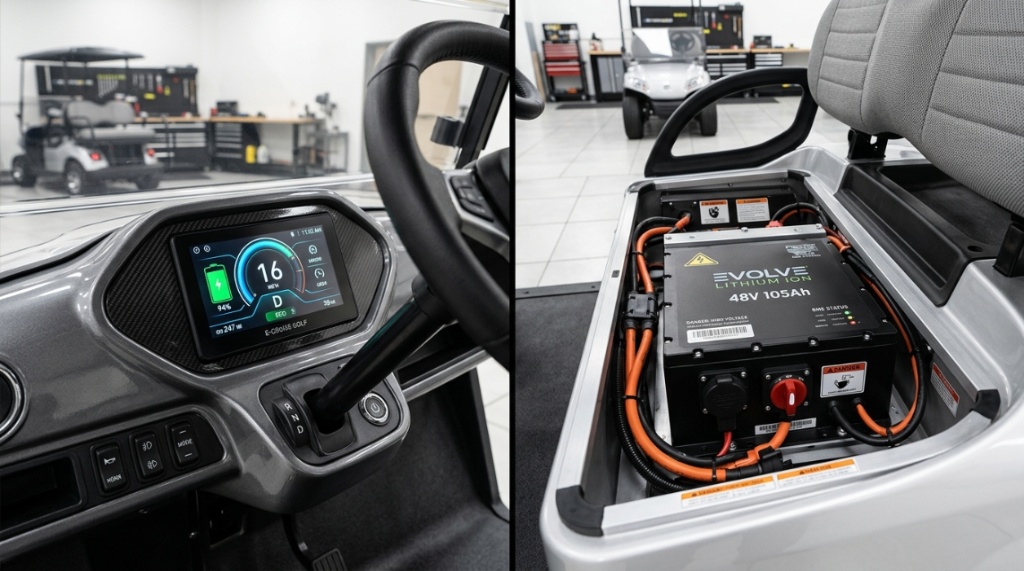
AC motors are more efficient, last longer, require less maintenance, and enable regenerative braking. DC motors cost less but wear faster due to carbon brushes that need periodic replacement.
Key differences:
- AC motors: Brushless design means no wearing parts. Regenerative braking recovers energy on downhills. Higher efficiency at all speeds. Standard on premium carts (Club Car, Yamaha current models).
- DC motors: Brush-based design requires brush replacement every 3–5 years ($100–$200). No regenerative braking. Less efficient at low speeds. Common on budget and older carts.
For daily-use adult carts, AC motors justify their premium. The maintenance savings alone ($200–$400 over 10 years in brush replacements) partially offset the higher purchase price. Regenerative braking adds 10–15% range in hilly terrain — meaningful for carts with limited battery capacity.
How Does Voltage Affect Golf Cart Performance?
Higher voltage systems deliver more power, faster acceleration, better hill climbing, and higher top speeds. A 48V system is the minimum for adult daily use; 72V systems suit demanding terrain or heavier loads.
Voltage comparison for practical use:
- 36V systems: Basic golf course use only. Struggles with hills, limited speed (12–15 mph), minimal accessory capacity. Being phased out by most manufacturers.
- 48V systems: Standard for modern adult carts. Adequate hill climbing, 19–25 mph speed, supports lighting and basic accessories. Best value for most buyers.
- 72V systems: Premium performance. Excellent hill climbing even with passengers, 25–35 mph capable, supports extensive accessories (heaters, sound systems, GPS). Higher cost and complexity.
Important: voltage alone doesn’t determine performance. A 48V system with a 500A controller outperforms a 72V system with a 300A controller in acceleration. Compare the complete electrical system, not just voltage.
Which Electric Golf Cart Brands Offer the Best Value?
Club Car, E-Z-GO, and Yamaha lead in reliability and resale value. Evolution and ICON offer more features per dollar but with less proven long-term track records.
Brand-by-brand comparison for adult buyers:
- Club Car Onward/Villager: Premium build quality, AC motor standard, excellent dealer network. Conservative styling. Best for buyers who prioritize reliability over features. Price: $8,000–$14,000.
- E-Z-GO Liberty/Freedom: Solid engineering, wide model range, strong parts availability. Good balance of features and reliability. Price: $7,500–$13,000.
- Yamaha Drive2/UMAX: Quietest operation, excellent suspension, strong resale. Limited customization options from factory. Price: $7,000–$12,000.
- Evolution Classic/Forester: Lithium standard, loaded with features (touchscreen, speakers, cameras), aggressive pricing. Chinese manufacturing with growing U.S. support. Price: $6,500–$11,000.
- ICON i40/i60: Budget-friendly with decent specs. Limited dealer network is the main concern. Price: $5,500–$9,000.
How Do You Compare Golf Cart Range and Battery Life Accurately?
Manufacturer range claims assume flat terrain, single rider, no accessories running, and new batteries at full capacity. Real-world range is typically 60–75% of advertised numbers.
Factors that reduce actual range:
- Terrain: Hills reduce range 20–40% compared to flat ground
- Passenger weight: Each additional passenger reduces range 10–15%
- Accessories: Lights, heaters, and sound systems draw from the same battery
- Temperature: Cold weather (below 50°F) reduces battery capacity 15–25%
- Battery age: Capacity degrades 2–5% per year even with proper maintenance
- Tire pressure: Under-inflated tires increase rolling resistance significantly
To compare range fairly between models: take the manufacturer’s claimed range and multiply by 0.65 for realistic daily-use expectations. A cart claiming 50 miles will realistically deliver 30–35 miles in mixed conditions.
What Safety Features Should You Compare Between Models?
Compare braking systems, lighting packages, structural integrity, and seatbelt availability. These features directly impact occupant safety, especially for street-legal neighborhood driving.
Safety features ranked by importance:
- Hydraulic disc brakes (vs. drum brakes): Better stopping power, especially when wet. Standard on premium models, optional on budget carts.
- DOT-rated headlights and taillights: Required for street-legal status. LED preferred for brightness and longevity.
- Turn signals and brake lights: Essential for road use. Surprisingly absent on many base models.
- Seatbelts: Required for LSV classification in most states. Three-point preferred over lap-only.
- Rearview mirrors: Basic safety requirement often sold as an “accessory” at markup.
- Parking brake: Should hold the cart on any grade without rolling. Test this during comparison drives.
- Structural roll cage or reinforced roof: Important if driving near traffic. Not all canopy tops provide structural protection.
How Do Warranty and After-Sales Support Compare Between Brands?
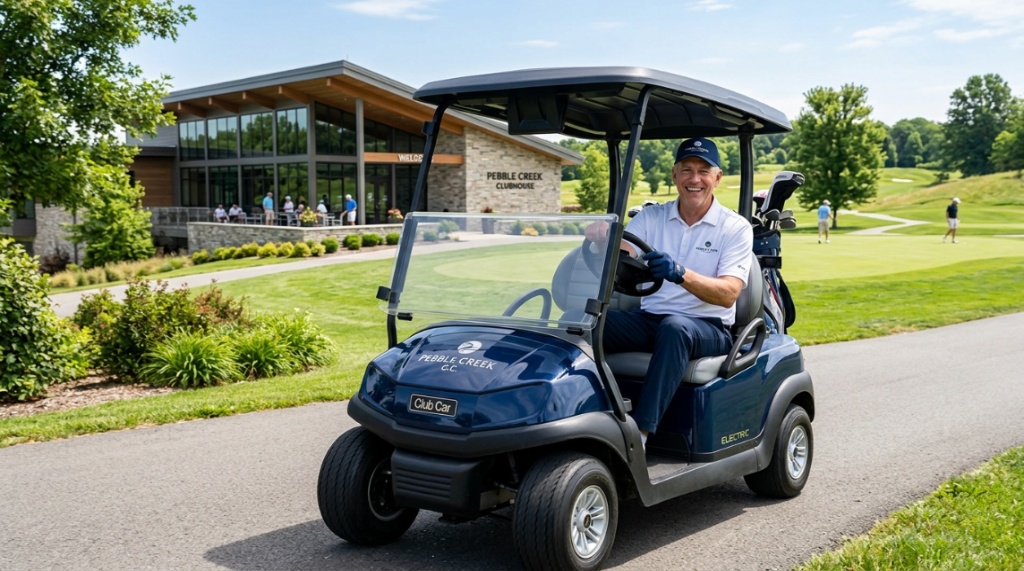
Club Car and Yamaha offer the strongest warranties (4–5 years limited). Budget brands typically offer 2 years. Warranty value depends entirely on local dealer availability for service.
Warranty comparison:
- Club Car: 4-year limited warranty (frame, motor, controller). 2-year battery warranty. Extensive dealer network.
- E-Z-GO: 4-year limited warranty. 2-year battery. Strong parts availability through Textron network.
- Yamaha: 5-year limited warranty (best in class). 2-year battery. Smaller dealer network than Club Car/E-Z-GO.
- Evolution: 2-year bumper-to-bumper. 5-year lithium battery warranty. Growing dealer network but still limited in some regions.
- ICON: 2-year limited warranty. Dealer network is the weakest among major brands.
Critical question before buying: Is there an authorized service center within 30 miles of your home? A 5-year warranty means nothing if the nearest dealer is 200 miles away.
Choosing the right ride is only half the battle when hitting the fairways. While mastering your vehicle’s specs ensures a smooth commute between holes, nailing your short game requires the right gear in your hands. If you are just starting out, pairing your new knowledge of cart features with the right Golf Putter for Beginner Men will instantly boost your confidence on the green and lower your scores.
Conclusion
Comparing electric golf carts properly means ignoring cosmetics and focusing on the engineering underneath — battery chemistry, motor type, voltage system, and controller specs. These four elements determine whether your cart delivers reliable daily service for a decade or becomes a maintenance headache within three years. The best golf cart comparison isn’t about which one looks nicest on the lot. It’s about which one still performs at year eight.
Use the comparison tables in this guide when evaluating options. Test drive every cart you’re considering on hills, not just flat lots. Ask dealers specific questions about motor type and controller amperage — if they can’t answer, find a dealer who can. Your purchase decision should be driven by data, not salesmanship.
Comparing specific models right now? List them in the comments with your use case and budget — I’ll break down which specs matter most for your situation.
Frequently Asked Questions
What is the best electric golf cart for adults in 2025?
The Club Car Onward with lithium battery package offers the best combination of reliability, performance, and resale value for adult daily use. For budget buyers, the Evolution Classic 4 provides more features per dollar with lithium standard at a lower price point.
How far can an electric golf cart go on one charge?
Lithium-equipped carts achieve 35–50 miles per charge in ideal conditions (25–35 miles real-world). Lead-acid carts achieve 15–25 miles per charge in ideal conditions (10–18 miles real-world). Terrain, weight, and temperature significantly affect actual range.
Are electric golf carts better than gas golf carts?
For most adult buyers, yes. Electric carts are quieter, cheaper to operate ($100–$200/year vs. $300–$500/year for gas), require less maintenance, and produce zero emissions. Gas carts offer unlimited range and faster refueling but at higher operating cost and noise levels.
How long do electric golf cart batteries last?
Lithium batteries last 8–10 years or 3,000–5,000 charge cycles. Lead-acid batteries last 3–5 years or 500–1,000 cycles. Proper charging habits (avoiding deep discharge, not leaving batteries depleted) maximize lifespan for both types.
What’s the difference between a 48V and 72V golf cart?
A 72V system delivers approximately 50% more power than a 48V system, resulting in faster acceleration, better hill climbing, higher top speed, and more capacity for accessories. The tradeoff is higher cost ($1,000–$2,000 more) and slightly more complex electrical system.
Do electric golf carts require a lot of maintenance?
Lithium-equipped electric carts require minimal maintenance — tire pressure checks, brake inspections, and occasional cleaning. Lead-acid carts require monthly battery watering, terminal cleaning, and equalization charges. Both types need far less maintenance than gas carts (no oil changes, spark plugs, or fuel system service).
Can I upgrade my golf cart from lead-acid to lithium batteries?
Yes. Lithium conversion kits cost $1,500–$3,500 depending on capacity and brand. The conversion typically takes 2–4 hours for a qualified technician. Benefits include 200–300 lb weight reduction, doubled range, eliminated maintenance, and faster charging. Most carts manufactured after 2010 are compatible with lithium conversions.



Leave a Reply