
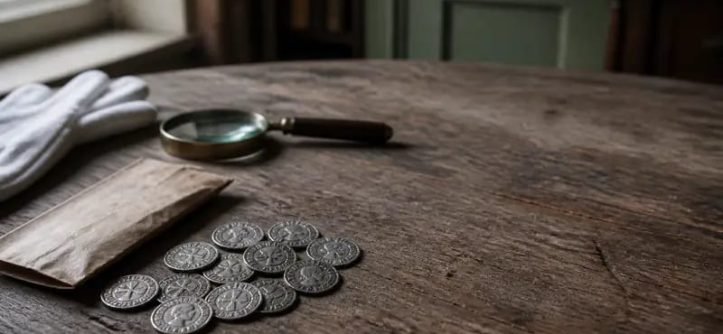
Lincolnshire Live has written its feature with the signal in the ground as the starting point and the sale at the end of the feature as the conclusion. It’s worth reading Lincolnshire Live’s report on the Burghley House coin hoard in full.
The word ‘disclaimed’ is used in the feature but without explanation. Once you have understood the legal term, the feature’s description of the coins going to auction through Hosker Haynes Auctioneers read well as the proper end of a well handled find.
What the feature gets right about the sequence
He handed over the coins to the nearest Finds Liaision Officer for the region ( Steve Jones of PAS Lincolnshire ) before doing anything else with them. The spot where he had found them all was noted to the best of his ability and he was asked to return to the spot in 2022 for a second search, which yielded 281 further coins from the same spot.
The test that decides whether coins are treasure
A group of coins can be considered treasure if, for example, at least two coins of the same type of find are over 300 years old. In terms of the percentage of precious metal in the coins by weight, according to the Treasure Act 1996 section 1, it has to be 10% or more. The coins from the Burghley House find are medieval silver pennies, which is the sort of thing that the Treasure Act is trying to cover. So although the find has been disclaimed, Stephen Stones can still sell the coins, as they were returned to him free of charge.
Why the law now looks beyond precious metal
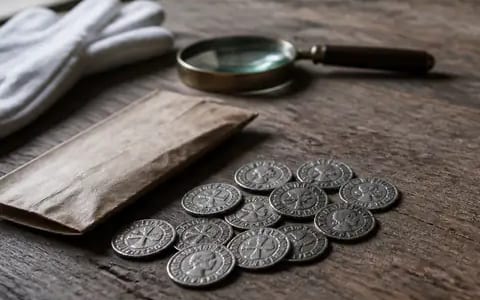
In 2023 the DCMS (Department for Culture, Media and Sport) announced new changes to the way treasure is defined. Now ‘treasure’ can be defined by a set of ‘wider criteria’ to ensure ‘more treasure can be displayed in museums’. So the whole process of a ‘hoard’ is to allow the public to have a first viewing and then it can be sold at auction.
Choosing a sale route once a hoard is returned.
When a hoard has been returned to the finder he can then hand over the hoard to sell through an auction house. Specialist coin auctioneers will typically list coins for sale in lots, and will want as much information as possible about the find and the coins, including the find spot details and the relevant PAS reference number(s). Here Hosker Haynes Auctioneers are working with Stephen towards a sale date in late March.
The sensible next step for any finder
In terms of a finding a hoard of coins, the most important thing is to keep all of the notes that you have recorded the find spot with, plus the reference number of the finds liaison officer that you reported the find to, plus the disclaimer letter. Take these to the auction house and give them to the auctioneer, along with the uncleaned coins. The folder with all of this paperwork will turn a bag of old pennies into a interesting find with a story to it that collectors will be able to bid on.


Leave a Reply