
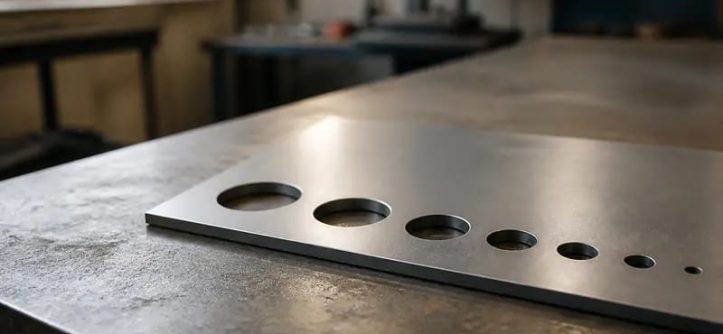
Sheet metal holes are one of the simplest features to define on a drawing. However, poorly defined holes can cause all sorts of problems including, split edges, cracked bridges and bent holes.
Keep Holes Larger Than Material Thickness
For laser cutting of holes the inside diameter should be at least 1.5 times the material thickness and ideally between 1.5 and 2 times the material thickness. For punching the inside diameter should be similar to laser cutting. Holes of 3 mm material should therefore be at least 3 mm in diameter and ideally 4.5 mm to 6 mm in diameter, depending on design.
Leave Enough Edge Distance
Material around a hole tears rather than cuts when holes are too close to edges. A suggested practice is to keep the edge of the hole from the edge of the part of at least the material thickness. In some instances, such as long slots, it is suggested that even more space is required.
Keep Holes Clear of Bend Lines
Do not place holes near bends as they will distort due to material stretching and compressing during forming. Leave at least 2.5 times the material thickness between the hole centre and the nearest bend line. This distance is measured on the inside of bends. Note on drawings where a hole is to be located close to a flange and allow sufficient space when performing the layout for possible relocation of the hole prior to cutting.
Space Multiple Holes Properly
Spaces between neighbouring holes should also be considered to avoid tensile stresses in the strip of material between the holes which can warp, bow or even crack during punching or forming. This is a greater problem on thinner gauges where the material has less capacity to absorb the stress. Allow a minimum of material thickness between edges of adjacent holes. If you want Sheet Metal Fabrication, https://dkmsheetmetal.co.uk/ is a good place to start.
Choose Round Holes Or Slots Deliberately
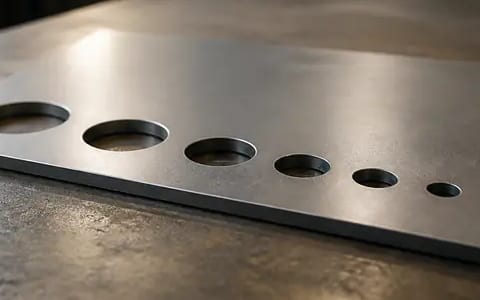
Whether to use round holes or slots, is dependent on the method by which your part is going to be cut. In many cases punched parts are restricted to standard diameter round holes that match the existing tool stations, in many cases these tooling sizes are not cost effective for one-off parts and even less so when making small quantities. In contrast laser cutting offers the user the ability to produce round holes, slots and even other irregular shapes as required.
Plan For Thread Depth In Thin Sheet
Sheet metal of thin thickness has not enough depth to hold sufficient number of turns of a thread for a through-hole to be safely and reliably screwed. This applies in particular for parts that are to be assembled and disassembled frequently. Instead of tapping through-holes for such parts, it is advisable to use threaded inserts or to have extruded holes formed that, on the resulting raised collar, screw-threads can be cut to required length.
Specify Countersinks And Counterbores Clearly
If you include countersinks and/or counterbores on your drawing for holes to receive screws, you need to include the depth and angle of the countersink(s). A standard angle for countersinks is 90 degrees (to fit standard screw heads). The depth must be sufficient to penetrate the material to the required depth for the screw to be seated flush to the material. Note that this can easily be a defined dimension that is ‘left’ on the drawing which is ‘acceptable’ until the parts are tried to assemble and fail to fit together.
Match Tolerance To The Cutting Method
Whether it is a requirement of the laser cutter or not, laser cut holes generally hold to a tighter tolerance than a hole that has been punched. This can be crucial when defining the measurement tolerances of a part and how these are verified. A tolerance on paper that looks to be very tight can often be found to be cost-prohibitive to achieve when actually required to be achieved with punched parts. These parts would typically only require very tight hole tolerances for location pins, bearings, etc. with the remainder of the holes on the part being released to a standard commercial tolerance for that part.
Hole sizing is a fundamental aspect of metal fabricating.


Leave a Reply