

Golf is a game of precision. Every detail matters, from the grip on your club to the condition of your ball. However, one piece of equipment gets overlooked far too often: the golf towel. In hot and humid weather, a poor towel choice can affect your grip, your club performance, and your overall comfort on the course.
Sweat is the enemy of a clean shot. Wet grips slip. Dirty clubfaces lose spin. Damp hands affect your swing mechanics. A good golf towel solves all of these problems. The challenge is knowing which towel to choose when the heat and humidity are working against you.
This golf towel buying guide covers everything you need to make the right decision. From materials and sizes to attachment features and care routines, you will have all the information you need before your next round.
Why Hot and Humid Weather Demands a Better Towel
A mild day on the course puts minimal demand on your towel. You might wipe your clubs once or twice and move on. However, when the temperature climbs above 30 degrees Celsius and humidity sits above 70 percent, the situation changes entirely.
Your hands sweat constantly. Your grips become slick. Grass and moisture cling to your clubfaces between shots. Even your golf ball can accumulate a fine film of moisture that affects how it leaves the face of your irons. A standard cheap towel becomes saturated quickly in these conditions. Once it is wet, it cannot absorb any more moisture and becomes useless for the rest of your round.
Therefore, choosing a towel specifically suited to heat and humidity is not just a comfort decision. It is a performance decision.
Understanding Golf Towel Materials
The material your towel is made from determines almost everything about how it performs. Different fabrics behave very differently when they come into contact with sweat and moisture. Understanding golf towel materials is the first and most important step in making the right choice.
Microfiber
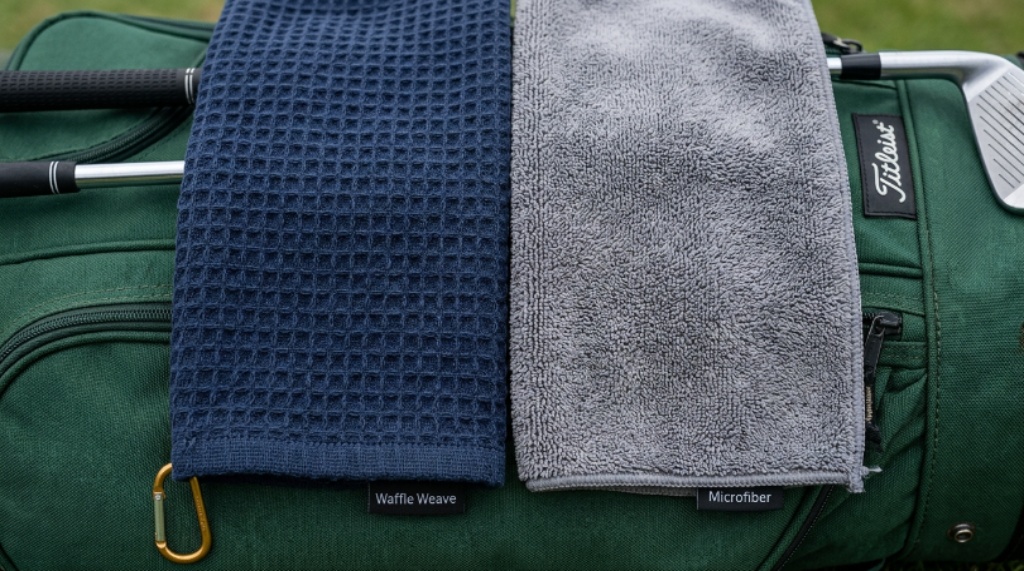
Microfiber is the most popular material for golf towels, and for good reason. It is made from ultra-fine synthetic fibres, typically a blend of polyester and polyamide. These fibres are far thinner than a human hair, which creates an enormous surface area within the fabric. That surface area is what makes microfiber so effective at absorbing moisture.
In hot and humid conditions, microfiber towels absorb sweat and water quickly and dry out fast. This means the towel remains effective for an entire 18-hole round rather than becoming saturated halfway through. Additionally, microfiber is lightweight and compact, which makes it easy to carry in your bag without adding unnecessary bulk.
The one downside of microfiber is that it can feel less luxurious than natural fibres. Some golfers find the texture slightly scratchy, particularly on skin. However, for pure performance in heat and humidity, microfiber is hard to beat.
Terry Cotton
Terry cotton is the traditional choice for golf towels. It has a looped pile structure that creates a soft, cushioned surface. This loop construction increases the fabric’s surface area, making it more absorbent than flat-woven cotton.
A high-quality terry cotton towel with a GSM (grams per square metre) rating between 400 and 600 is genuinely absorbent and feels excellent to the touch. However, the drawback in hot and humid weather is drying time. Cotton retains moisture longer than microfiber. Once a thick terry cotton towel becomes saturated, it stays wet for a long time. On a long summer round, this can become a problem.
If you prefer the feel of cotton, look for a lighter-weight option in the 300 to 400 GSM range. Thinner cotton towels dry faster while still providing reasonable absorbency.
Waffle Weave Fabric
Waffle weave is a textured cotton or cotton-blend fabric with a distinctive grid pattern. The raised squares and recessed channels in the weave create extra surface area that traps and lifts dirt and moisture from clubfaces very effectively.
Many golfers prefer waffle weave specifically for cleaning club grooves because the texture acts almost like a scrubbing pad. Additionally, the open weave structure allows air to circulate through the fabric, which speeds up drying compared to traditional terry cotton. For hot and humid conditions where club cleaning is a priority, waffle weave is an excellent choice.
Chamois and Synthetic Leather
Some premium golf towels use a chamois-style material, either genuine leather or a synthetic alternative. These towels are incredibly soft and absorb moisture extremely well. They are also very easy to wring out and reuse during a round, which makes them practical in heavy humidity.
However, genuine chamois towels require more careful maintenance and can deteriorate if not cared for properly. Synthetic chamois options offer similar performance with easier care requirements. These are a good choice for golfers who prioritise feel and wringing ability over everything else.
Golf Towel Sizes Explained
Golf towels come in a range of sizes, and the right choice depends on how you plan to use yours. Understanding the standard golf towel sizes helps you match your purchase to your needs on the course.
Small Clip Towels (approximately 30 x 50 cm)
Small towels are designed to clip onto your bag and stay accessible throughout your round. They are light, easy to handle with one hand, and do not flap around in the wind. However, their small surface area limits their usefulness for thorough club cleaning or wiping down your hands and arms.
In hot weather, a small towel saturates faster because there is less fabric to distribute moisture across. For this reason, many golfers in humid climates use a small towel as a secondary option while keeping a larger towel in their bag.
Medium Towels (approximately 40 x 60 cm to 45 x 75 cm)
Medium towels are the most popular size for everyday golfers. They offer enough surface area to clean clubs, wipe hands, and still have dry fabric left after several uses. They attach easily to a bag strap or ring clip and are not so large that they become cumbersome.
For hot and humid conditions, a medium microfiber towel in this size range is often the ideal combination of practicality and performance.
Large and Oversized Towels (approximately 50 x 100 cm and above)
Large towels provide the most absorbent capacity and the most surface area for cleaning. Some golfers prefer to drape them over their bag or fold them across their arm. They are particularly useful during very wet or heavily humid rounds where you need to wipe down repeatedly without worrying about running out of dry fabric.
The trade-off is weight and bulk. A large wet towel adds noticeable weight to your bag. Additionally, large towels can be harder to manage on windy days.
Attachment Features That Matter on the Course
How a towel attaches to your bag affects how convenient it is during a round. In hot weather, you want your towel accessible without having to stop and search for it.
Most golf towels include a brass or nickel grommet near one corner. A metal clip hooks through this grommet to attach the towel to a bag ring, strap, or trolley handle. Look for a clip that opens and closes smoothly and does not corrode in humid conditions. Cheap zinc clips rust quickly when exposed to repeated moisture and sweat.
Some towels use a central hanging loop rather than a corner grommet. This design means you can fold the towel in half and attach it so that one side hangs wet and one hangs dry. The dry side is then always available for your next shot. This is a practical feature worth looking for specifically in humid climates where the towel gets wet frequently.
Additionally, magnetic attachment systems have appeared in recent years. These replace the traditional clip with a strong magnet that attaches directly to metal surfaces on your bag. They are fast and convenient, though they do require a compatible bag surface to work properly.
How to Keep Your Golf Towel Performing at Its Best
Even the best towel becomes less effective if it is not cared for properly. Microfiber in particular requires specific washing habits to maintain its absorbency over time.
Wash microfiber towels separately from cotton items. Cotton fibres shed lint during washing, and that lint clogs the fine fibres of microfiber, reducing its ability to absorb moisture. Use a small amount of liquid detergent and avoid fabric softener entirely. Fabric softener coats microfiber fibres with a waxy residue that dramatically reduces absorbency.
For cotton and waffle weave towels, a standard warm wash is fine. Tumble dry on a low heat setting or hang to air dry. Avoid high heat, which can cause shrinkage and damage the weave structure over time.
Carrying two towels on a hot round is a sensible strategy. One stays clipped to your bag for quick club wipes. The second stays clean and dry in an outer pocket until you need it in the back nine when your first towel has seen heavy use.
Conclusion
Choosing the right golf towel for hot and humid weather comes down to three core decisions: material, size, and attachment. Microfiber leads the way for performance in heat and humidity thanks to its fast drying time and high absorbency. Waffle weave is an excellent choice for club cleaning. Terry cotton offers comfort but dries more slowly.
Medium-sized towels hit the sweet spot between coverage and practicality for most golfers. A central hanging loop design helps you always have a dry surface available. Look for corrosion-resistant clips and consider carrying a spare towel on very hot days.
This golf towel buying guide gives you everything you need to make a confident, informed choice. The right towel keeps your grips dry, your clubs clean, and your game sharp no matter how high the temperature climbs. Do not let something this small and affordable hold back your performance on the course.
Frequently Asked Questions
What is the best golf towel material for hot and humid conditions?
Microfiber is the top choice for hot and humid weather. It absorbs moisture quickly, dries fast, and stays effective throughout a full round. Waffle weave cotton is a strong alternative if you prioritise club cleaning over hand drying.
How often should I wash my golf towel?
After every round, ideally. In hot and humid conditions, towels accumulate sweat, grass, and sunscreen residue quickly. Regular washing maintains absorbency and prevents unpleasant odours from developing in the fabric.
Can I use a regular bath towel instead of a golf towel?
You can, but it is not practical. Bath towels are too large and heavy to carry comfortably. They also lack attachment hardware and dry slowly. A purpose-made golf towel is more convenient and performs better on the course.
What size golf towel is best for beginners?
A medium-sized towel in the 40 x 60 cm to 45 x 75 cm range is the best starting point. It provides enough surface area for both hand wiping and club cleaning without being too bulky or heavy to carry comfortably.
Why does my microfiber golf towel feel less absorbent after washing?
This is almost always caused by fabric softener. Fabric softener leaves a coating on microfiber fibres that blocks moisture absorption. Rewash the towel using only a small amount of liquid detergent and no softener. Absorbency usually returns within one or two washes.



Leave a Reply